
The bleaching privilege strengthens Chemnitz as a center of linen production.
Chemnitz · Textile History
Chemnitz Textile History – a Common Thread.
In Chemnitz, fibers were not just processed. New machines, factories, and entire industries grew out of trade and craftsmanship. This journey through time follows the textile common thread – from the bleaching privilege of 1357 to the Chemnitz I call home today.
13571728180018832022
Nine stations
About fibers, people, and machines.
The textile history of Chemnitz did not follow a straight path. Handwork was followed by specialized manufactories, mechanized spinning mills, and machinery manufacturing of international significance. Crises, persecution, and war left deep breaks. The common thread connects the most important stations here – condensed, but not shortened.
The production of cotton stockings, gloves, and caps begins.
With Saxony's first mechanized cotton spinning mills, the factory era begins.
Saxon machine factories are located in Chemnitz in 1851.
Condensed according to the accompanying volume of the Chemnitz Industrial Museum.9
01 · The Beginning
1357
The bleaching privilege creates a center.
On December 14, 1357, the Margraves of Meissen allowed the establishment of a state bleaching facility on the Chemnitz. At the same time, the export of flax, yarn, and unbleached linen was restricted. Bleachers, weavers, dyers, and merchants thus formed a coherent textile economy at an early stage.139
02 · Diversity before the factory
1532–1780
From linen, fustian, calico, and knitwear are made.
In 1532, the regulations of the Chemnitz Barchent weavers were confirmed. Later, calico printing, silk knitting, and new cotton fabrics expanded the range. From 1728, cotton stockings, gloves, and caps were also produced. In 1780, 540 master weavers worked in the city with 600 journeymen on around 1,300 to 1,400 hand looms – in addition to the many home workers in the surrounding area.269
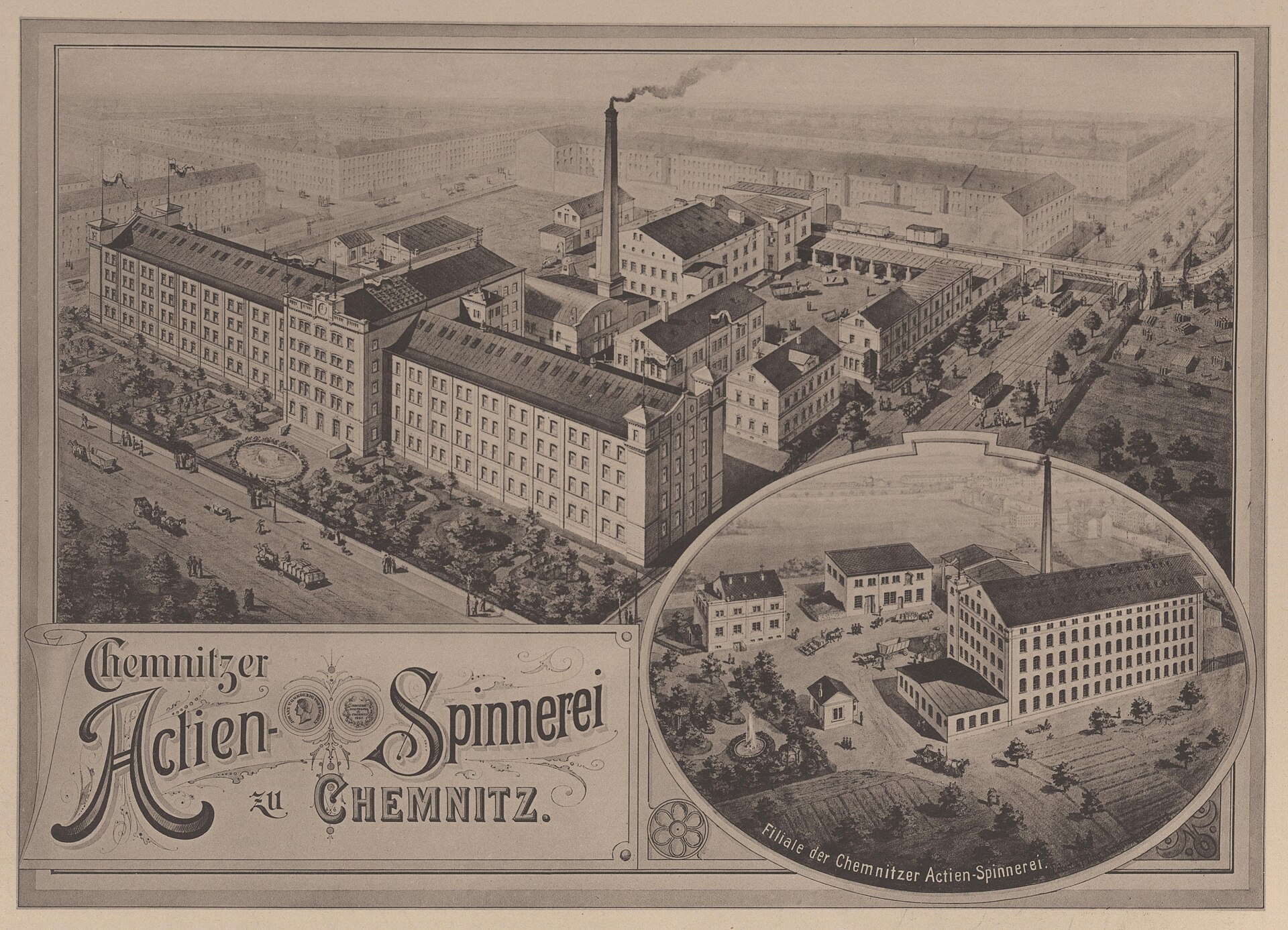
03 · The leap to the factory
1799–1802
Water power sets thousands of spindles in motion.
The first mechanical cotton spinning mills of Saxony emerged in Harthau and Furth. English technology, inventors from Chemnitz, and water-powered machines met centuries-old textile knowledge here. Around 1800, this marked the beginning of the Saxon factory era – and step by step, the textile city also became a machine engineering city.9
1800first water-powered mechanical cotton spinning mills
7.344Spindles in Harthau as early as 1804
10.000 → 68.000Population from 1801 to 1871
04 · Machines for Knitting
1851
Textile knowledge becomes knitting machine engineering.
With industrialization, not only did the production of fabrics and knitted goods grow. Companies in Chemnitz also began to develop the machines for it. In 1851, 20 of the 32 Saxon machine factories were located in Chemnitz. In the same year, Gottfried Martin Hilscher founded a knitting machine factory – an important step for the city's specialized machine engineering.49
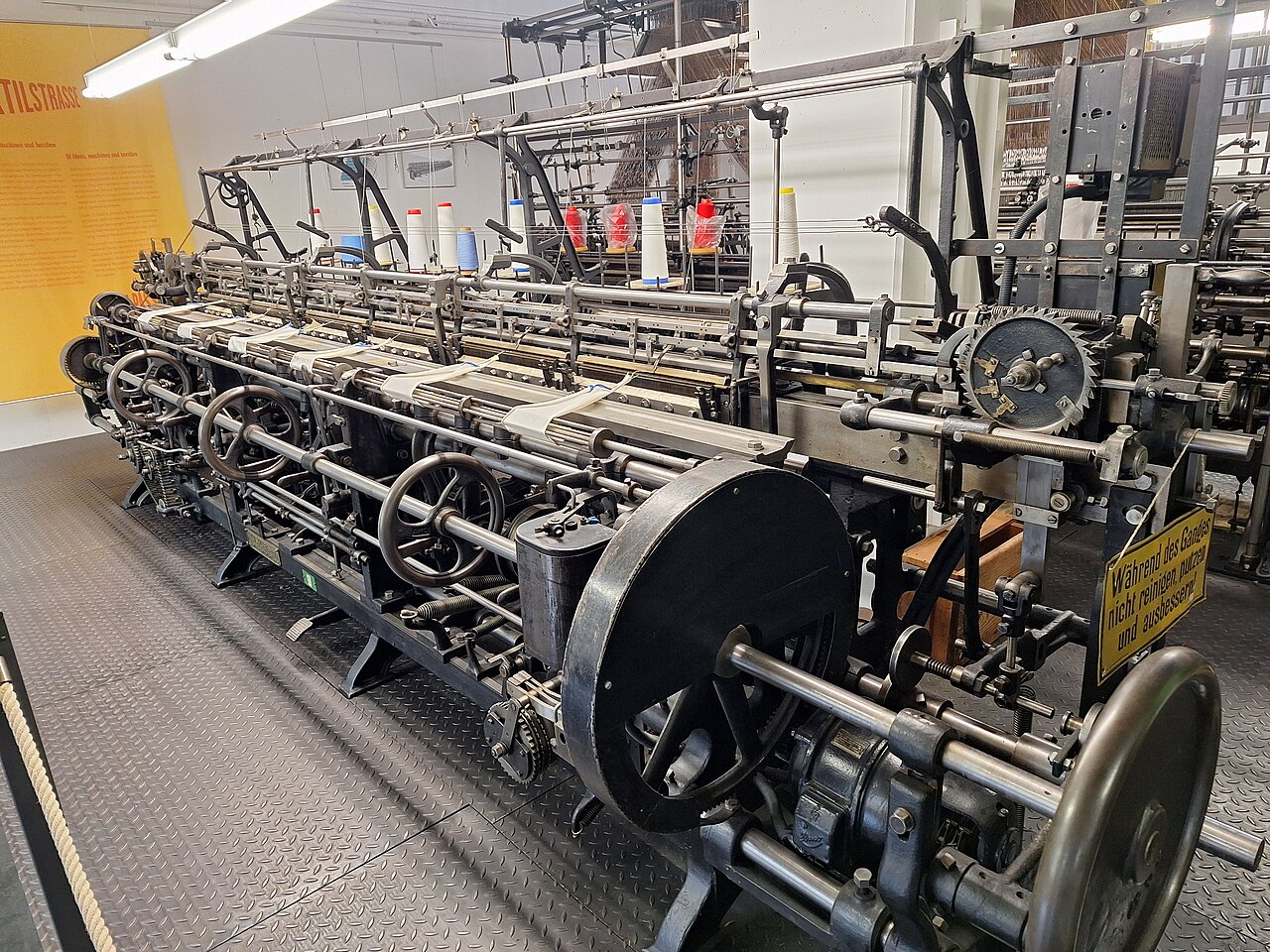
05 · Specialization
1883
Schubert & Salzer begins with stocking machines.
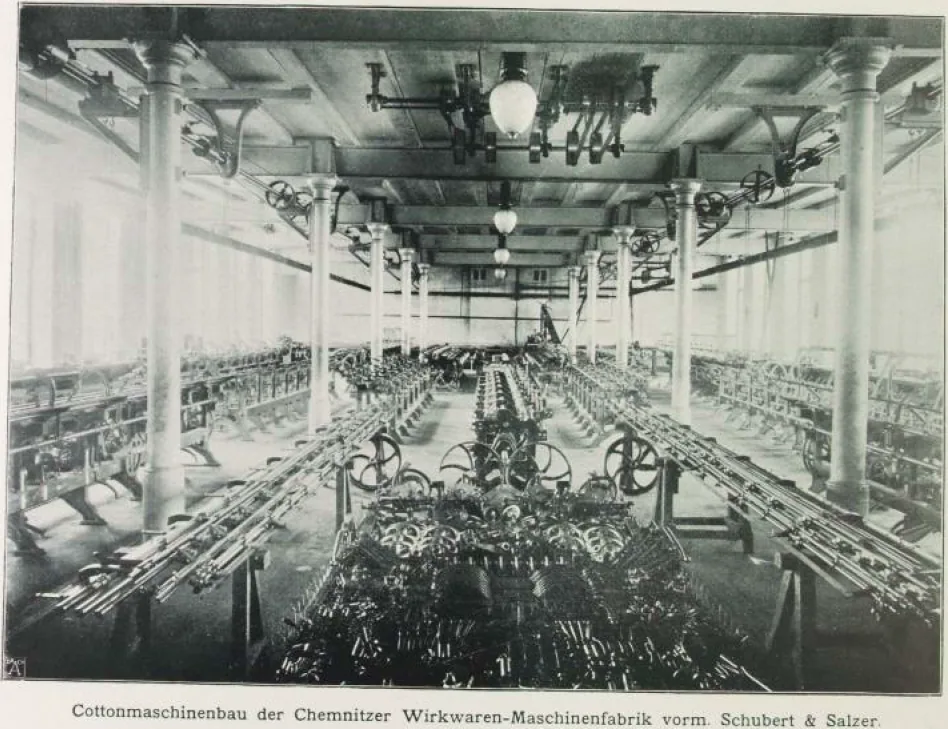
In 1883, the company began building stocking machines. In 1889, this developed into the Chemnitz Knitting Machine Factory. Around 1900, photographs already show large machine halls: textiles and mechanical engineering were closely connected in Chemnitz.47
06 · Visible heritage
1927–32
Industry leaves architecture and signs behind.
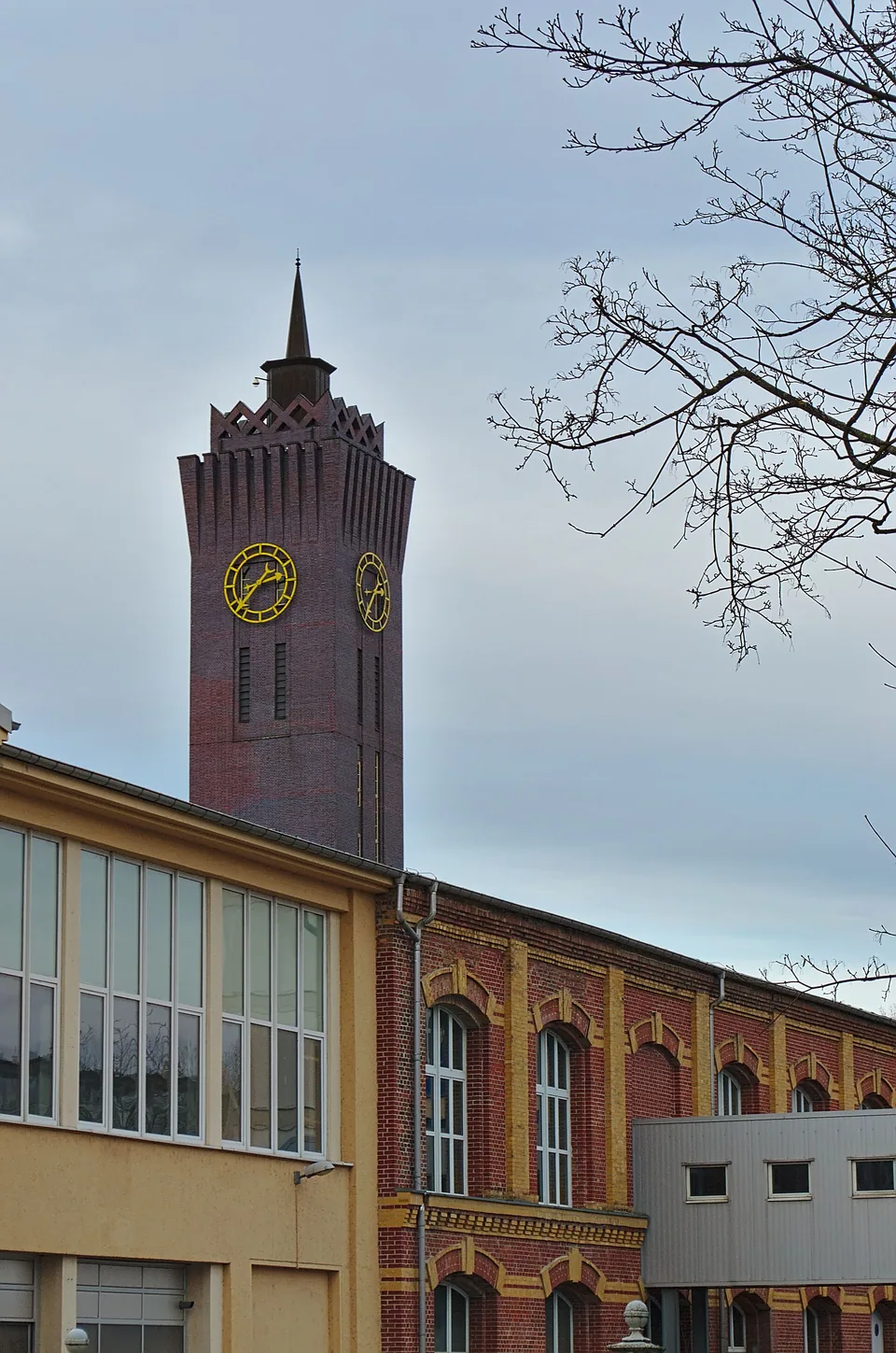
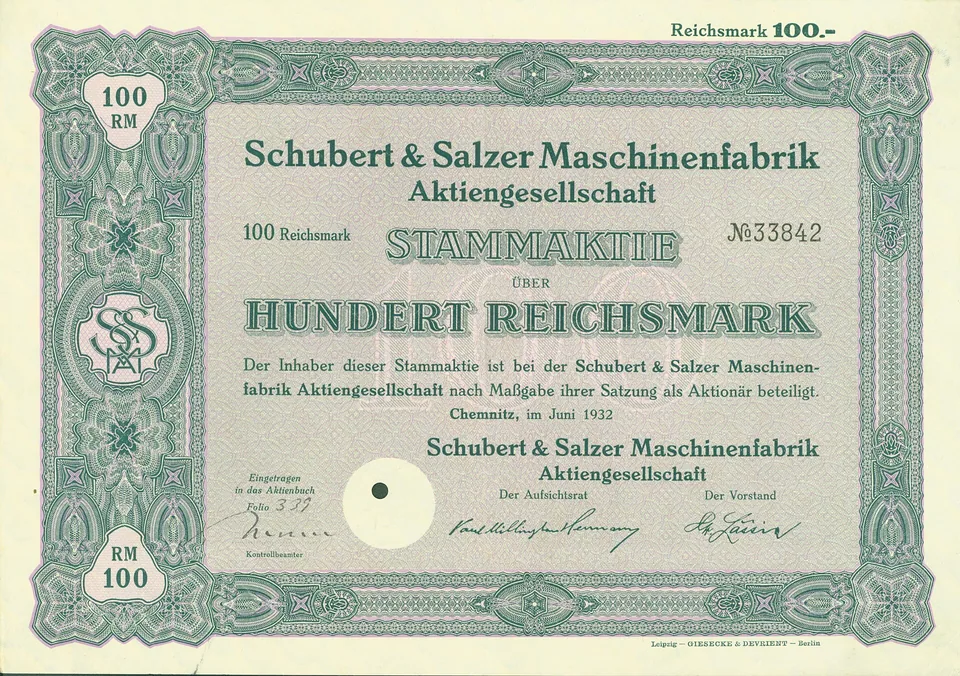
The distinctive clock tower on the grounds of Schubert & Salzer was built in 1927 and 1928 according to designs by the Chemnitz architect Erich Basarke. A security from 1932 simultaneously documents the corporate world of that time – two very different testimonies of the same era.7
07 · Worldliness and violent rupture
1930–39
Jewish entrepreneurs shaped the textile city – until the persecution.
In 1930, there were 601 hosiery and knitting businesses in Chemnitz; 212 of them were Jewish-owned. Companies and trade relationships made the city internationally visible. From 1933 onwards, Jewish owners were persecuted, expropriated, and pushed out of economic life. By 1939, this engagement, which had grown over decades, had been largely violently ended.9
601Hosiery and knitting businesses
212of which were Jewish-owned
35,3 %Share – larger than in any other German city
08 · Knowledge remains in motion
1960
Knitting machine manufacturing remains part of the city.
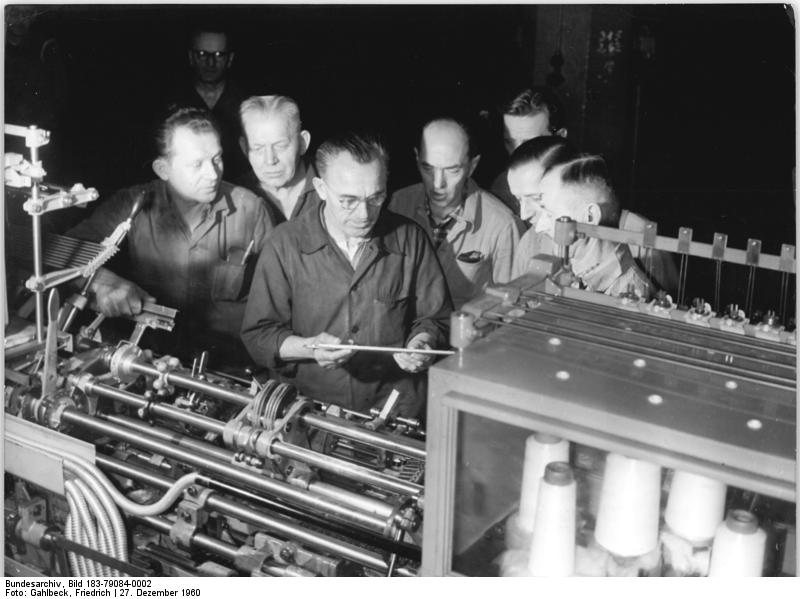
Even after the Second World War, knitting and knitting machines were developed and built in Karl-Marx-Stadt. The photograph from 1960 shows employees of VEB Knitting Machine Manufacturing working together on a machine.8
09 · A beginning of its own
2022
KNITSCHI emerges in Chemnitz.
Since 2022, the KNITSCHI hat and the 2-in-1 solution made of 100% alpaca wool have been created in my workshop: worked on the knitting machine, then finished by hand and personally inspected. Chemnitz is not just a backdrop, but my home and the place where every KNITSCHI piece is created.
Get to know the production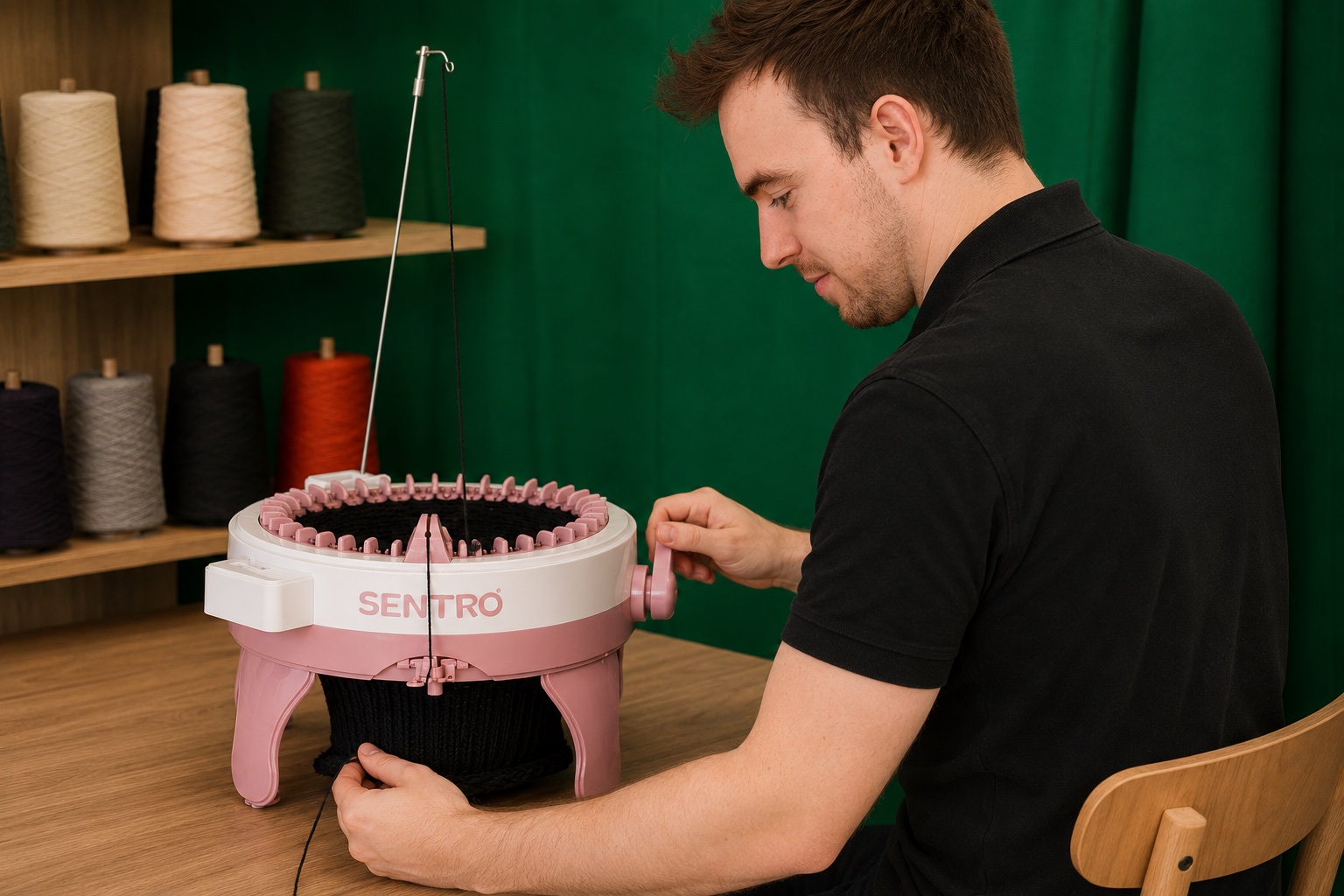
Traces to this day
History that lives on in buildings and collections.
Historical factory buildings, machines, samples, and photographs preserve the many layers of this development. They tell of inventiveness and work, but also of exploitation, persecution, war, and new beginnings. The Chemnitz Industrial Museum makes numerous testimonies accessible and places them within Saxon industrial history.
Visit the Chemnitz Industrial Museum ↗Comprehensible
Sources and further reading.
The historical statements are based on publications by the city of Chemnitz, the Chemnitz Industrial Museum, and an accompanying volume on Chemnitz's industrial culture. Copyright and licensing information for each used image is collected in the image credits.
- 01City of Chemnitz: The Bleaching Privilege of 1357 ↗
- 02City of Chemnitz: Industrial History ↗
- 03City of Chemnitz: Historical Timeline ↗
- 04Chemnitz Industrial Museum: Schubert & Salzer and the Knitting Machine Construction ↗
- 05Chemnitz Industrial Museum: Site History ↗
- 06Chemnitz Industrial Museum: Stockings "Made in Saxony" ↗
- 07City of Chemnitz: Clock Tower of the Company Schubert & Salzer ↗
- 08Chemnitz Industrial Museum: VEB Knitting Machine Construction Karl-Marx-Stadt ↗
- 09
Chemnitz Industrial Museum: Industrial Archaeology – The Heart of Chemnitz. 220 Years of Industrial Culture (Accompanying Book to the Special Exhibition)